Active Listening in Marriage: Steps to Feel Truly Heard
The single most effective way to break the cycle of repeated fights is to practice active listening: focus fully on your spouse, reflect what you heard, and validate their feelings before you say a word in response. Three things you can do right now:
- Put your phone in another room. Physical removal beats flipping it face-down. Even a visible phone pulls attention.
- Use a 2-minute reflection. After your spouse finishes speaking, pause and say, “What I hear you saying is…” then repeat the core of what they shared in your own words. Ask, “Did I get that right?”
- Ask before you fix. Before responding, say: “Do you want me to listen, or are you looking for help solving this?” That one question prevents the most common listening failure in marriage.
These three moves cost nothing and work immediately. The rest of this guide builds on them with habits, a full practice exercise, and clear signs that you may need professional support.
Key Takeaways
Active listening in marriage works because it shifts the listener’s goal from responding to genuinely understanding, and that shift, practiced consistently, changes how safe and close a marriage feels.
| Point | Details |
|---|---|
| Start with presence | Remove phones and distractions before any meaningful conversation begins. |
| Reflect, then validate | Repeat the core of what your spouse said in your own words, then acknowledge the feeling before you respond. |
| Ask before fixing | “Do you want me to listen or help?” prevents the most common listening failure in marriage. |
| Practice the 6-step exercise | Use the speaker-listener structure weekly during calm moments to build skill before conflict demands it. |
| Itsadivinelife’s Divine Marriage Program | Combines licensed counseling with biblical principles for couples whose patterns need structured, professional support. |
Table of Contents
- How active listening in marriage actually changes things
- Small daily habits that make listening noticeably better
- A 6-step listening exercise you can practice at home
- How body language and setting shape whether listening feels real
- Common listening mistakes and what to say instead
- Why this works: what the research actually says
- When active listening isn’t enough and you need professional help
- A note on faith and why this practice matters
- How Itsadivinelife supports couples who are ready for more
- Sources
How active listening in marriage actually changes things
Most couples think they listen. What they actually do is wait. They hear the first sentence, form a response, and spend the next two minutes rehearsing it while their spouse is still talking. Rogers and Farson’s foundational work on active listening identified this decades ago: the listener’s job is not to answer but to test understanding, reflecting meaning back in their own words and waiting for the speaker to confirm accuracy before moving on.
That shift, from answering to understanding, is what makes listening feel different to a spouse. When your partner feels genuinely heard, they disclose more, defend less, and stay calmer during hard conversations. Clinical literature on interpersonal listening consistently links high-quality listening and perceived partner responsiveness to greater self-disclosure and relational closeness. The mechanism is straightforward: feeling heard signals safety, and safety lowers the emotional cost of being honest.
Small daily habits that make listening noticeably better
Big change in marriage communication usually starts with small, repeatable behaviors, not dramatic conversations. These habits are low-effort and high-return:
- Set a talking time. Pick a 10-minute window each day, after dinner or before bed, with no agenda except checking in. Consistency matters more than length.
- One topic per conversation. When a discussion starts to drift into three grievances at once, gently say, “Can we finish this one first?” It keeps both of you from feeling buried.
- Name what you notice. Instead of asking “What’s wrong?”, try “You seem tired tonight. Want to talk, or just be together?” It signals attention without pressure.
- Validate before you pivot. Before offering a different perspective, say, “That makes sense” or “I can see why you’d feel that way.” Utah State University Extension’s guidance on active listening frames validation as a distinct step, not a courtesy, because skipping it makes the rest of the conversation feel dismissive.
- Reflect the emotion, not just the content. “You sound frustrated” lands differently than “So you’re saying the meeting ran long.” Content paraphrasing is a start; emotional reflection is the goal.
- Use the speaker’s own words. When you reflect back, borrow a word or phrase they used. It signals you were actually tracking, not just waiting for your turn.
- End with a check-in. Close the conversation with, “Is there anything else you wanted me to understand?” It catches what got left out and signals you’re not rushing to be done.
Pro Tip: Start with a low-stakes topic, something like weekend plans or a frustrating work moment, before using these habits during conflict. Practicing when emotions are low builds the muscle memory you’ll need when they’re not.
A 6-step listening exercise you can practice at home
This structure comes directly from clinician-authored couples therapy practice and is designed to be used at home, either as a weekly check-in or during a calm moment after a disagreement. Set aside 20 minutes. Sit facing each other with phones out of the room.
- Speaker chooses one topic. Keep it specific: one feeling, one situation, one need. Not “our whole communication problem.”
- Listener sets a silent intention. Before the speaker starts, the listener says quietly: “I’m going to listen and reflect back what I hear. Correct me if I’m wrong.” This reduces the pressure on both sides.
- Speaker talks for 3–4 minutes uninterrupted. The listener does not nod excessively, does not say “I understand” repeatedly, and does not plan a response. Just listen.
- Listener reflects in their own words. Not a word-for-word repeat. Something like: “What I’m hearing is that you felt left out when I made that decision without asking you. Is that right?” Wait for the speaker to confirm or correct.
- Speaker confirms or clarifies. If the reflection missed something, the speaker says so without frustration: “Almost, but the bigger thing was…” Then the listener reflects again.
- Listener validates. After the reflection is confirmed, the listener says something that acknowledges the feeling: “That makes sense. I’d feel the same way.” No fixing, no defending, no “but.” Just acknowledgment.
Repeat steps 4–6 until the speaker says they feel understood. Then switch roles.
**Sample dialogue:**Speaker: “I felt really alone last week when you kept working late and didn’t tell me ahead of time.” Listener: “So what I’m hearing is that the late nights weren’t the hardest part, it was not knowing. You felt left out of the plan. Did I get that?” Speaker: “Yes, exactly.” Listener: “That makes sense. Not knowing is harder than the actual schedule.”

Pro Tip: During an active conflict, use a shorter version: 2 minutes of speaking, one reflection, one validation. Save the full 6-step exercise for calmer moments. Using it mid-fight for the first time usually backfires because neither person has the emotional bandwidth to follow the structure.
How body language and setting shape whether listening feels real
You can say all the right words and still communicate that you’re not really there. Nonverbal signals carry as much weight as the words themselves, sometimes more.
What to do with your body:
- Face your partner directly. Turning slightly away, even toward a TV that’s off, signals divided attention.
- Lean slightly forward. It reads as engaged, not aggressive.
- Make steady, natural eye contact. You don’t need to stare; breaking eye contact briefly is normal. But dissertation research on 80 romantic couples found associations between direct gaze and later positivity resonance, suggesting that eye contact during listening isn’t just polite, it’s structurally connected to how good the conversation feels afterward.
- Keep your arms uncrossed and your hands relaxed. Crossed arms signal defensiveness even when you don’t feel defensive.
What to do with the environment:
- Turn off the TV completely, not just mute it. A muted screen still pulls the eye.
- Put phones in another room, not just face-down on the table. Research on presence training from University of Cincinnati counseling advisors treats visible-phone removal as the first structural step toward perceived safety in conversation.
- Choose a quiet, private space. Background noise raises the cognitive load of listening and makes it harder to track emotional nuance.
- Sit at the same level. One person standing while the other sits creates a subtle power imbalance that affects how safe disclosure feels.
A simple phrase that signals availability: “I want to hear this. Give me one second to put my phone away.” That sentence alone communicates more than most people realize.
Common listening mistakes and what to say instead
These behaviors look like listening but consistently undermine connection:
- Planning your rebuttal while they speak. You catch about 30% of what’s said when you’re composing a response. Instead: hold your response until they finish, then reflect before you reply.
- Jumping to solutions. “Here’s what you should do” shuts down emotional disclosure fast. Instead: “Do you want help thinking through this, or do you mostly need me to hear it?”
- Interrupting to agree. Even positive interruptions (“Yes, exactly!”) break the speaker’s train of thought and shift focus to you. Let them finish.
- Minimizing feelings. “It’s not that bad” or “You’re overreacting” are the fastest ways to end honest conversation. Instead: “That sounds really hard.” Full stop.
- Mechanical paraphrasing without presence. Repeating words back robotically, while looking at the floor or sounding bored, is worse than not paraphrasing at all. Therapist guidance on active listening for couples is direct on this: paraphrasing without genuine empathy feels patronizing and can deepen disconnection rather than repair it.
- Skipping validation to get to your point. When a speaker doesn’t feel acknowledged, they repeat themselves, louder and with more emotion, until they do. One sentence of validation, “That sounds exhausting,” stops that cycle before it starts.
Why this works: what the research actually says
Active listening produces measurable relational benefits, and the mechanisms are specific enough to be worth understanding.
Perceived partner responsiveness is the technical term for feeling that your spouse understands, values, and cares about what you share. Clinical and empirical literature links this perception to greater willingness to disclose, lower defensiveness, and stronger relational wellbeing. Listening behaviors, reflecting, validating, staying present, are the primary way partners signal responsiveness to each other.
Sensory connection matters more than most couples expect. The Zhou dissertation study of 80 romantic couples found associations between enacted listening, direct gaze, and later positivity resonance. The findings are from a specific archival sample and should be read cautiously, but the direction is consistent with what therapists observe clinically: the physical conditions of listening, where you sit, whether you make eye contact, whether distractions are removed, shape how the conversation is experienced emotionally.
Emotional safety functions as a precondition. When a spouse doesn’t feel safe disclosing, better listening technique alone won’t open them up. Safety comes from consistency: showing up the same way in low-stakes conversations builds the credibility that makes high-stakes ones possible.
The Rogers and Farson framework ties these mechanisms together: when a listener reflects meaning and waits for confirmation, the speaker experiences being understood as an active event, not a passive one. That experience is what shifts the emotional register of a conversation.
| Mechanism | What it means in practice |
|---|---|
| Perceived partner responsiveness | Feeling heard lowers defensiveness and increases willingness to share |
| Direct gaze and sensory connection | Eye contact during listening is linked to more positive conversation outcomes |
| Emotional safety | Consistent presence in low-stakes talks builds trust for harder ones |
| Validation before response | Acknowledging feelings before replying prevents repetitive escalation |
When active listening isn’t enough and you need professional help
Skill-building has limits. These are signs that the problem is bigger than technique:
- You feel unsafe being honest. If you edit what you say because you’re afraid of your spouse’s reaction, that’s not a listening problem.
- The same fight cycles back every few weeks. Demand-withdraw patterns, where one person pushes and the other shuts down, are notoriously hard to break without a structured outside perspective.
- Emotional flooding stops conversations cold. When one or both of you reaches a point where rational conversation becomes impossible, the nervous system is running the show, not the skill set.
- One or both of you has stopped trying. Contempt, stonewalling, or consistent avoidance of any meaningful conversation are late-stage warning signs.
- There’s unresolved trauma, substance use, or ongoing emotional harm. Active listening exercises are not appropriate as the primary intervention in these situations.
If two or more of these apply, a licensed couples therapist can provide what a guide cannot: a structured, safe environment with a trained third party who can interrupt patterns in real time.
To bring it up with your spouse, try: “I’ve been reading about communication and I think we’re both trying. I’d like us to talk to someone together, not because we’re failing, but because I think we deserve more support than we can give each other right now.”
A note on faith and why this practice matters
At Divine Life, the approach to listening in marriage is grounded in both clinical practice and the conviction that being truly heard is one of the most profound ways spouses reflect care for each other. The exercises in this guide are the same ones used in structured couples work, and they work precisely because they slow the conversation down enough for both people to feel seen.
What faith adds is not a different technique but a different motivation: the belief that your spouse’s inner life is worth your full attention, not because the conversation is easy, but because the relationship is worth it. That orientation, showing up with patience and genuine curiosity, is what separates practiced skill from real connection.
How Divine Life supports couples who are ready for more

Self-practice gets couples a long way. When the patterns are deeper, or when you’ve tried the exercises and the same walls keep coming up, working with a trained counselor changes the dynamic in ways a guide can’t replicate.
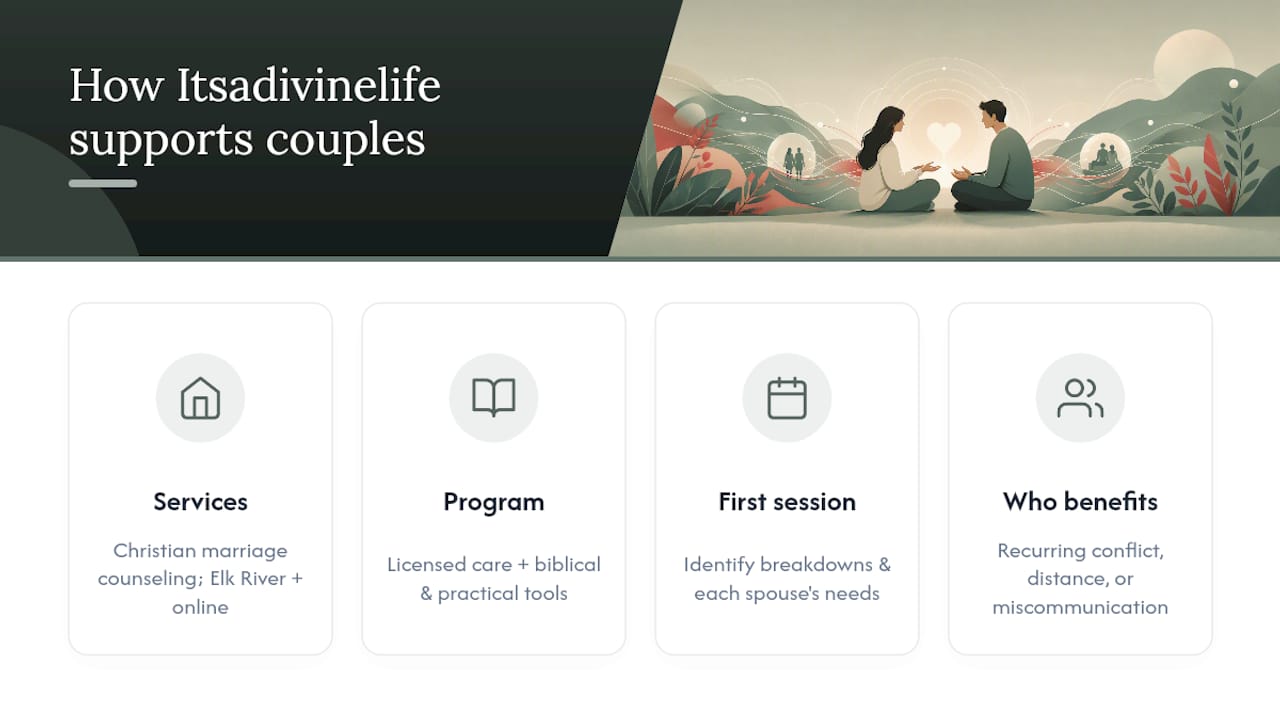
Itsadivinelife offers Christian marriage counseling and couples therapy in Elk River, MN, with online sessions available nationwide. The Divine Marriage Program combines licensed clinical care with biblical principles and practical communication tools, structured to address the specific patterns that keep couples stuck. A first session focuses on understanding where communication breaks down and what each spouse actually needs to feel heard.
Couples who benefit most are those dealing with recurring conflict cycles, emotional distance, or a sense that they’re talking past each other despite genuine effort. If that sounds familiar, the next step is straightforward: book a session with Divine Life and bring the exercises from this guide into a supported environment where a counselor can help you use them when it counts.
Sources
These are the primary sources cited in this guide, each worth reading directly if you want to go deeper:
- This 6-Step Listening Technique Can Save Your Relationship | Psychology Today
- Rogers & Farson — Active Listening (reprint) | Empathy Matters
- Using Active Listening to Enhance Your Relationships | Utah State University Extension
- Listen to Resonate: Testing Listening’s Reciprocal Links to Sensory Connection, Perceived Safety and Interpersonal Positivity Resonance — Jieni Zhou (dissertation)
- PMC article related to interpersonal listening and relational outcomes | PMC